Real project / Engineering evidence
LUOKAVRION Shopify Theme Customization and Interaction Engineering Case Study
WhaleLeap delivered bounded Shopify theme and frontend customization for LUOKAVRION, connecting Liquid sections, JSON templates, Theme Editor configuration, and a first-visit Three.js experience in the published storefront.
View live storeProject type
Shopify Theme Customization
Engineering scope
Liquid · JSON templates · JavaScript · Three.js
Release state
Published theme verified
Public relationship
Client-controlled footer attribution
01 / Challenge
A strong visual entry cannot block product discovery or purchase access.
A model-kit and collectibles storefront needs a distinctive first impression while keeping navigation, product discovery, and commerce entry points usable. Motion also needs explicit fallbacks and cleanup for reduced-motion preferences, hidden pages, and navigation away.
02 / Verified scope
The customization scope WhaleLeap can substantiate.
This case describes only implementation supported by source, the published theme, and the public storefront. It does not claim authorship of the base theme, the complete visual design, or every storefront feature.
03 / Design to live
From Figma page structure to the live Shopify storefront.
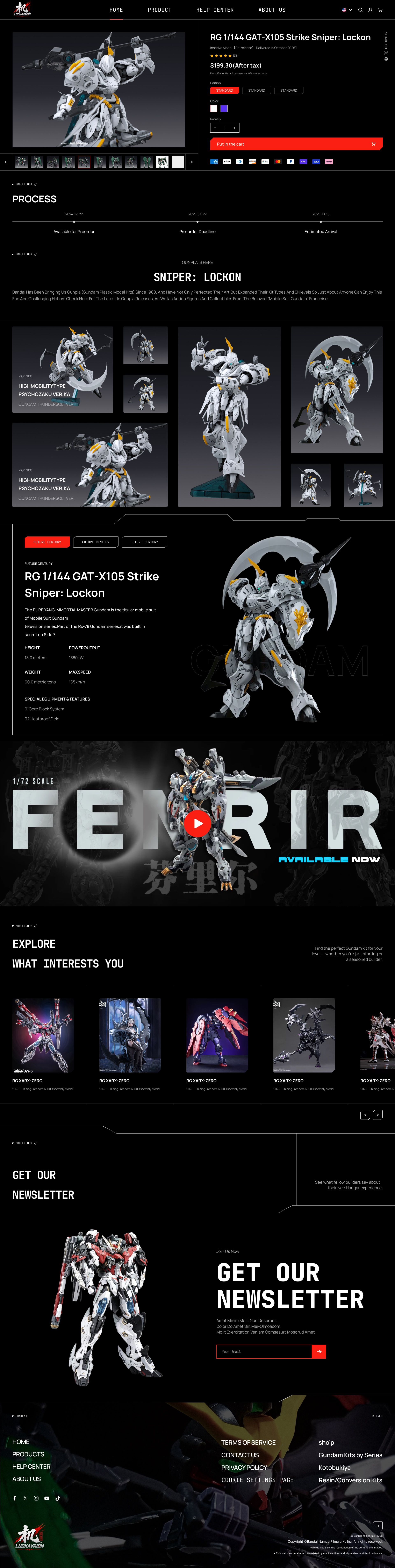
This project highlights the Figma designs for LUOKAVRION's homepage and product detail page, along with their implementation in the live Shopify storefront. WhaleLeap Studio translated the core page structures into maintainable Liquid sections, JSON templates, and responsive frontend interactions.
Homepage Design
The homepage direction connects brand entry, product discovery, editorial guidance, community content, service assurance, and newsletter paths.

Product Detail Design
The product-detail direction organizes purchase controls, product media, product storytelling, specifications, related discovery, and newsletter entry.
04 / Shopify architecture
From JSON template composition to configurable Liquid modules.
The homepage template composes modules; section schemas expose settings, blocks, and presets; Liquid renders storefront content; CSS and JavaScript handle responsive presentation and interaction.
01
JSON template
Defines homepage module order and configuration instances
02
Liquid sections
Render hero, product showcase, newsletter, and assurance modules
03
Schema
Exposes visible settings, content fields, blocks, and presets
04
Storefront
Renders the configured modules on the live store
05 / Merchant editability
Configuration structure is verified; editor lifecycle claims stay bounded.
The published JSON template and section schemas were inspected read-only, confirming configuration structure and visible fields. Because no state-changing test was performed, saving, reordering, and adding or deleting blocks are not described as verified.
VERIFIED
- Section settings
- Content fields
- Blocks
- Presets
- JSON composition
NOT_VERIFIED
- Save changes
- Section reorder
- Add/delete blocks
06 / Frontend interaction
Three.js is bounded to a first-visit brand entry experience.
The published theme contains a custom entry script loaded by the theme layout. Source verification covers first-visit state, prefers-reduced-motion, page visibility, listener cleanup, animation-frame cancellation, and Three.js resource disposal. It is not described as a product configurator, and no design authorship is inferred.
07 / Responsive implementation
Responsive implementation and interaction safeguards share one delivery boundary.
The customized modules include responsive layout and frontend interaction work. Current evidence supports source-to-live structure, but a single public visit is not expanded into a claim of complete cross-device or transaction coverage.
08 / Engineering evidence
Key engineering files were compared directly with the Published Theme.
Seven key Liquid and JavaScript files match the current Published Theme exactly; the homepage index.json is structurally and semantically equivalent. Internal theme identifiers, Admin details, and complete client source remain private.
L4 / Published theme
The active production theme, target store, and live domain were verified read-only.
L4 / File comparison
Seven key Liquid / JS files match exactly; index.json is semantically equivalent.
L4 / Configuration
Representative section settings, blocks, and presets were verified from schemas and template structure.
L5 / Public attribution
The live footer displays Customized by WhaleLeap Studio and links to the official WhaleLeap website.
09 / Live outcome
The verifiable outcome is a live, maintainable customized Shopify storefront.
The customized theme work is present in the current Published Theme, and the client-controlled live site publicly attributes WhaleLeap Studio. This case makes no claim about revenue, conversion lift, performance scores, GA4/GTM outcomes, or client reviews.
View live store10 / Claim boundary
Evidence boundaries deliberately retained.
- Figma supports only a bounded design-to-live structure comparison; no pixel-perfect reproduction or complete original design ownership is claimed.
- Theme Editor save, reorder, and block add/delete actions were not performed or marked verified.
- Theme IDs, Admin captures, full source, contracts, and sensitive client information remain private.
- Public media and sanitized code excerpts are used only within the confirmed permission scope.
Need to turn an existing theme into a configurable, maintainable Shopify experience?
Start with the theme structure, Liquid modules, Theme Editor configuration, and frontend interactions to decide what is worth customizing.